 Add to Chrome
 Add to Firefox
 Add to Edge
Taming Preference Mode Collapse via Directional Decoupling Alignment in Diffusion Reinforcement Learning
Dec 30, 2025
Recent studies have demonstrated significant progress in aligning text-to-image diffusion models with human preference via Reinforcement Learning from Human Feedback. However, while existing methods achieve high scores on automated reward metrics, they often lead to Preference Mode Collapse (PMC)-a specific form of reward hacking where models converge on narrow, high-scoring outputs (e.g., images with monolithic styles or pervasive overexposure), severely degrading generative diversity. In this work, we introduce and quantify this phenomenon, proposing DivGenBench, a novel benchmark designed to measure the extent of PMC. We posit that this collapse is driven by over-optimization along the reward model's inherent biases. Building on this analysis, we propose Directional Decoupling Alignment (D$^2$-Align), a novel framework that mitigates PMC by directionally correcting the reward signal. Specifically, our method first learns a directional correction within the reward model's embedding space while keeping the model frozen. This correction is then applied to the reward signal during the optimization process, preventing the model from collapsing into specific modes and thereby maintaining diversity. Our comprehensive evaluation, combining qualitative analysis with quantitative metrics for both quality and diversity, reveals that D$^2$-Align achieves superior alignment with human preference.

Bridging Cognitive Gap: Hierarchical Description Learning for Artistic Image Aesthetics Assessment
Dec 29, 2025The aesthetic quality assessment task is crucial for developing a human-aligned quantitative evaluation system for AIGC. However, its inherently complex nature, spanning visual perception, cognition, and emotion, poses fundamental challenges. Although aesthetic descriptions offer a viable representation of this complexity, two critical challenges persist: (1) data scarcity and imbalance: existing dataset overly focuses on visual perception and neglects deeper dimensions due to the expensive manual annotation; and (2) model fragmentation: current visual networks isolate aesthetic attributes with multi-branch encoder, while multimodal methods represented by contrastive learning struggle to effectively process long-form textual descriptions. To resolve challenge (1), we first present the Refined Aesthetic Description (RAD) dataset, a large-scale (70k), multi-dimensional structured dataset, generated via an iterative pipeline without heavy annotation costs and easy to scale. To address challenge (2), we propose ArtQuant, an aesthetics assessment framework for artistic images which not only couples isolated aesthetic dimensions through joint description generation, but also better models long-text semantics with the help of LLM decoders. Besides, theoretical analysis confirms this symbiosis: RAD's semantic adequacy (data) and generation paradigm (model) collectively minimize prediction entropy, providing mathematical grounding for the framework. Our approach achieves state-of-the-art performance on several datasets while requiring only 33% of conventional training epochs, narrowing the cognitive gap between artistic images and aesthetic judgment. We will release both code and dataset to support future research.
ArtCrafter: Text-Image Aligning Style Transfer via Embedding Reframing
Jan 03, 2025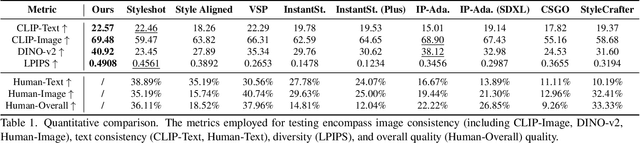
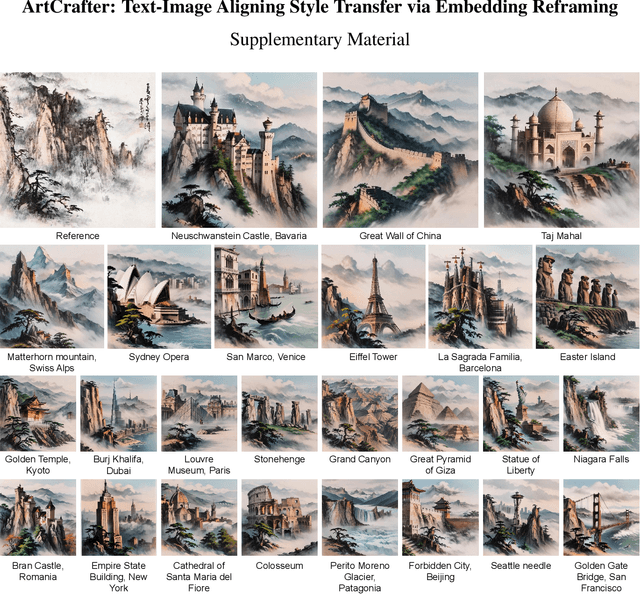
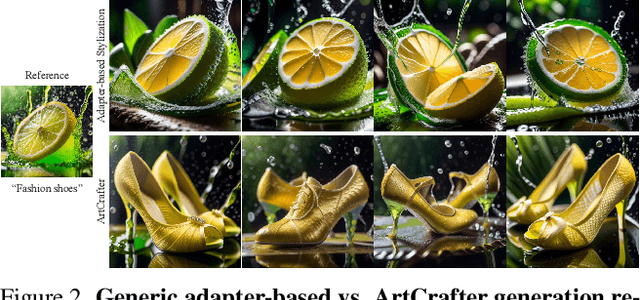
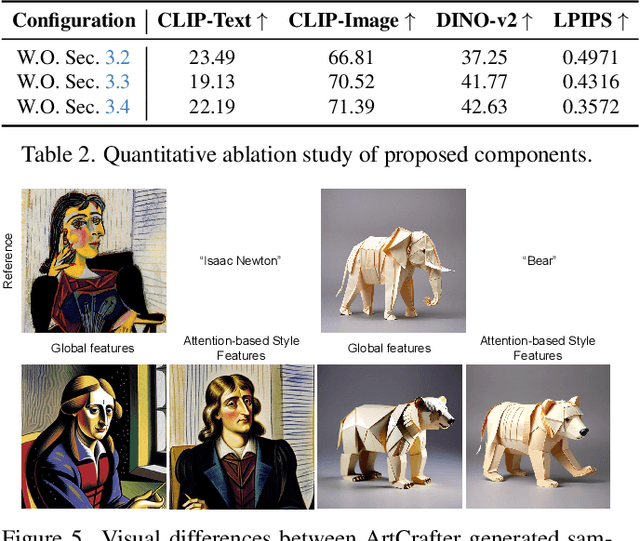
Recent years have witnessed significant advancements in text-guided style transfer, primarily attributed to innovations in diffusion models. These models excel in conditional guidance, utilizing text or images to direct the sampling process. However, despite their capabilities, direct conditional guidance approaches often face challenges in balancing the expressiveness of textual semantics with the diversity of output results while capturing stylistic features. To address these challenges, we introduce ArtCrafter, a novel framework for text-to-image style transfer. Specifically, we introduce an attention-based style extraction module, meticulously engineered to capture the subtle stylistic elements within an image. This module features a multi-layer architecture that leverages the capabilities of perceiver attention mechanisms to integrate fine-grained information. Additionally, we present a novel text-image aligning augmentation component that adeptly balances control over both modalities, enabling the model to efficiently map image and text embeddings into a shared feature space. We achieve this through attention operations that enable smooth information flow between modalities. Lastly, we incorporate an explicit modulation that seamlessly blends multimodal enhanced embeddings with original embeddings through an embedding reframing design, empowering the model to generate diverse outputs. Extensive experiments demonstrate that ArtCrafter yields impressive results in visual stylization, exhibiting exceptional levels of stylistic intensity, controllability, and diversity.
Taming Rectified Flow for Inversion and Editing
Nov 07, 2024

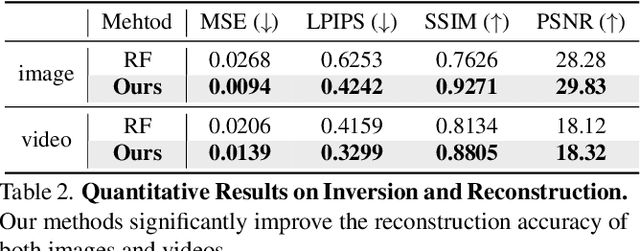

Rectified-flow-based diffusion transformers, such as FLUX and OpenSora, have demonstrated exceptional performance in the field of image and video generation. Despite their robust generative capabilities, these models often suffer from inaccurate inversion, which could further limit their effectiveness in downstream tasks such as image and video editing. To address this issue, we propose RF-Solver, a novel training-free sampler that enhances inversion precision by reducing errors in the process of solving rectified flow ODEs. Specifically, we derive the exact formulation of the rectified flow ODE and perform a high-order Taylor expansion to estimate its nonlinear components, significantly decreasing the approximation error at each timestep. Building upon RF-Solver, we further design RF-Edit, which comprises specialized sub-modules for image and video editing. By sharing self-attention layer features during the editing process, RF-Edit effectively preserves the structural information of the source image or video while achieving high-quality editing results. Our approach is compatible with any pre-trained rectified-flow-based models for image and video tasks, requiring no additional training or optimization. Extensive experiments on text-to-image generation, image & video inversion, and image & video editing demonstrate the robust performance and adaptability of our methods. Code is available at https://github.com/wangjiangshan0725/RF-Solver-Edit.
CreativeSynth: Creative Blending and Synthesis of Visual Arts based on Multimodal Diffusion
Jan 30, 2024Large-scale text-to-image generative models have made impressive strides, showcasing their ability to synthesize a vast array of high-quality images. However, adapting these models for artistic image editing presents two significant challenges. Firstly, users struggle to craft textual prompts that meticulously detail visual elements of the input image. Secondly, prevalent models, when effecting modifications in specific zones, frequently disrupt the overall artistic style, complicating the attainment of cohesive and aesthetically unified artworks. To surmount these obstacles, we build the innovative unified framework CreativeSynth, which is based on a diffusion model with the ability to coordinate multimodal inputs and multitask in the field of artistic image generation. By integrating multimodal features with customized attention mechanisms, CreativeSynth facilitates the importation of real-world semantic content into the domain of art through inversion and real-time style transfer. This allows for the precise manipulation of image style and content while maintaining the integrity of the original model parameters. Rigorous qualitative and quantitative evaluations underscore that CreativeSynth excels in enhancing artistic images' fidelity and preserves their innate aesthetic essence. By bridging the gap between generative models and artistic finesse, CreativeSynth becomes a custom digital palette.
MotionCrafter: One-Shot Motion Customization of Diffusion Models
Dec 08, 2023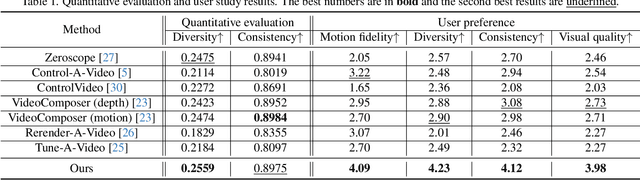
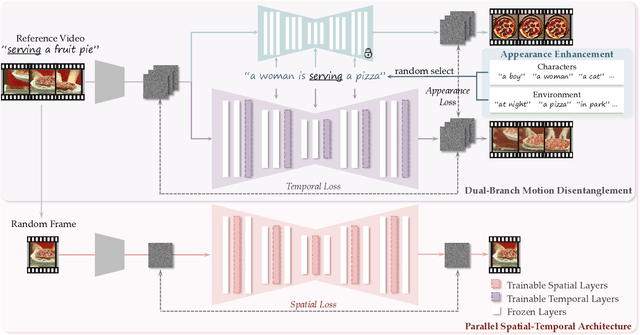
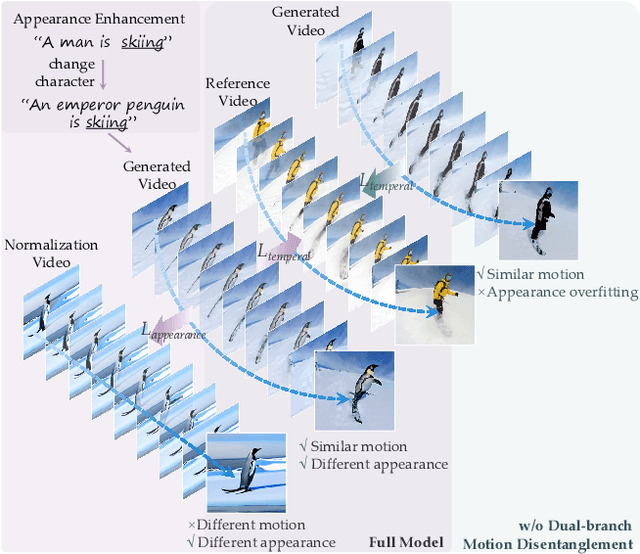
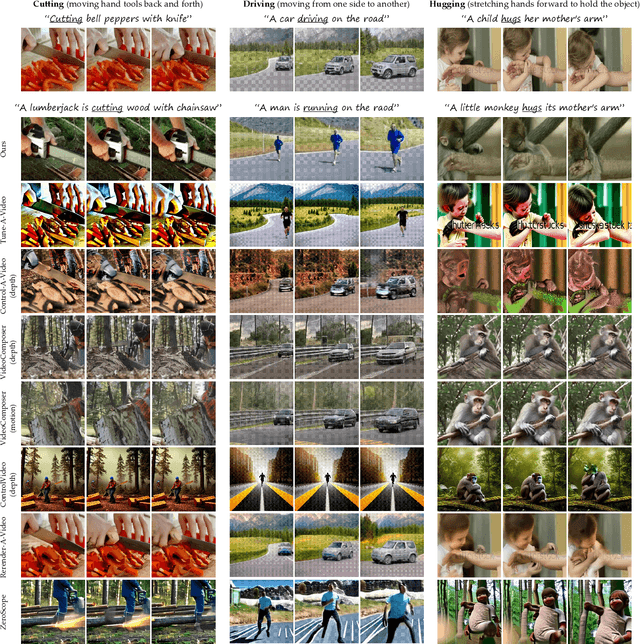
The essence of a video lies in its dynamic motions, including character actions, object movements, and camera movements. While text-to-video generative diffusion models have recently advanced in creating diverse contents, controlling specific motions through text prompts remains a significant challenge. A primary issue is the coupling of appearance and motion, often leading to overfitting on appearance. To tackle this challenge, we introduce MotionCrafter, a novel one-shot instance-guided motion customization method. MotionCrafter employs a parallel spatial-temporal architecture that injects the reference motion into the temporal component of the base model, while the spatial module is independently adjusted for character or style control. To enhance the disentanglement of motion and appearance, we propose an innovative dual-branch motion disentanglement approach, comprising a motion disentanglement loss and an appearance prior enhancement strategy. During training, a frozen base model provides appearance normalization, effectively separating appearance from motion and thereby preserving diversity. Comprehensive quantitative and qualitative experiments, along with user preference tests, demonstrate that MotionCrafter can successfully integrate dynamic motions while preserving the coherence and quality of the base model with a wide range of appearance generation capabilities. Codes are available at https://github.com/zyxElsa/MotionCrafter.
ProSpect: Expanded Conditioning for the Personalization of Attribute-aware Image Generation
May 25, 2023


Personalizing generative models offers a way to guide image generation with user-provided references. Current personalization methods can invert an object or concept into the textual conditioning space and compose new natural sentences for text-to-image diffusion models. However, representing and editing specific visual attributes like material, style, layout, etc. remains a challenge, leading to a lack of disentanglement and editability. To address this, we propose a novel approach that leverages the step-by-step generation process of diffusion models, which generate images from low- to high-frequency information, providing a new perspective on representing, generating, and editing images. We develop Prompt Spectrum Space P*, an expanded textual conditioning space, and a new image representation method called ProSpect. ProSpect represents an image as a collection of inverted textual token embeddings encoded from per-stage prompts, where each prompt corresponds to a specific generation stage (i.e., a group of consecutive steps) of the diffusion model. Experimental results demonstrate that P* and ProSpect offer stronger disentanglement and controllability compared to existing methods. We apply ProSpect in various personalized attribute-aware image generation applications, such as image/text-guided material/style/layout transfer/editing, achieving previously unattainable results with a single image input without fine-tuning the diffusion models.
Style-A-Video: Agile Diffusion for Arbitrary Text-based Video Style Transfer
May 09, 2023Large-scale text-to-video diffusion models have demonstrated an exceptional ability to synthesize diverse videos. However, due to the lack of extensive text-to-video datasets and the necessary computational resources for training, directly applying these models for video stylization remains difficult. Also, given that the noise addition process on the input content is random and destructive, fulfilling the style transfer task's content preservation criteria is challenging. This paper proposes a zero-shot video stylization method named Style-A-Video, which utilizes a generative pre-trained transformer with an image latent diffusion model to achieve a concise text-controlled video stylization. We improve the guidance condition in the denoising process, establishing a balance between artistic expression and structure preservation. Furthermore, to decrease inter-frame flicker and avoid the formation of additional artifacts, we employ a sampling optimization and a temporal consistency module. Extensive experiments show that we can attain superior content preservation and stylistic performance while incurring less consumption than previous solutions. Code will be available at https://github.com/haha-lisa/Style-A-Video.
Region-Aware Diffusion for Zero-shot Text-driven Image Editing
Feb 23, 2023Image manipulation under the guidance of textual descriptions has recently received a broad range of attention. In this study, we focus on the regional editing of images with the guidance of given text prompts. Different from current mask-based image editing methods, we propose a novel region-aware diffusion model (RDM) for entity-level image editing, which could automatically locate the region of interest and replace it following given text prompts. To strike a balance between image fidelity and inference speed, we design the intensive diffusion pipeline by combing latent space diffusion and enhanced directional guidance. In addition, to preserve image content in non-edited regions, we introduce regional-aware entity editing to modify the region of interest and preserve the out-of-interest region. We validate the proposed RDM beyond the baseline methods through extensive qualitative and quantitative experiments. The results show that RDM outperforms the previous approaches in terms of visual quality, overall harmonization, non-editing region content preservation, and text-image semantic consistency. The codes are available at https://github.com/haha-lisa/RDM-Region-Aware-Diffusion-Model.
Inversion-Based Creativity Transfer with Diffusion Models
Nov 23, 2022In this paper, we introduce the task of "Creativity Transfer". The artistic creativity within a painting is the means of expression, which includes not only the painting material, colors, and brushstrokes, but also the high-level attributes including semantic elements, object shape, etc. Previous arbitrary example-guided artistic image generation methods (e.g., style transfer) often fail to control shape changes or convey semantic elements. The pre-trained text-to-image synthesis diffusion probabilistic models have achieved remarkable quality, but they often require extensive textual descriptions to accurately portray attributes of a particular painting. We believe that the uniqueness of an artwork lies precisely in the fact that it cannot be adequately explained with normal language. Our key idea is to learn artistic creativity directly from a single painting and then guide the synthesis without providing complex textual descriptions. Specifically, we assume creativity as a learnable textual description of a painting. We propose an attention-based inversion method, which can efficiently and accurately learn the holistic and detailed information of an image, thus capturing the complete artistic creativity of a painting. We demonstrate the quality and efficiency of our method on numerous paintings of various artists and styles. Code and models are available at https://github.com/zyxElsa/creativity-transfer.